ARIA: Sustained Autonomous Research
One research kernel, adapted across three organizations, published, and still running on borrowed iron
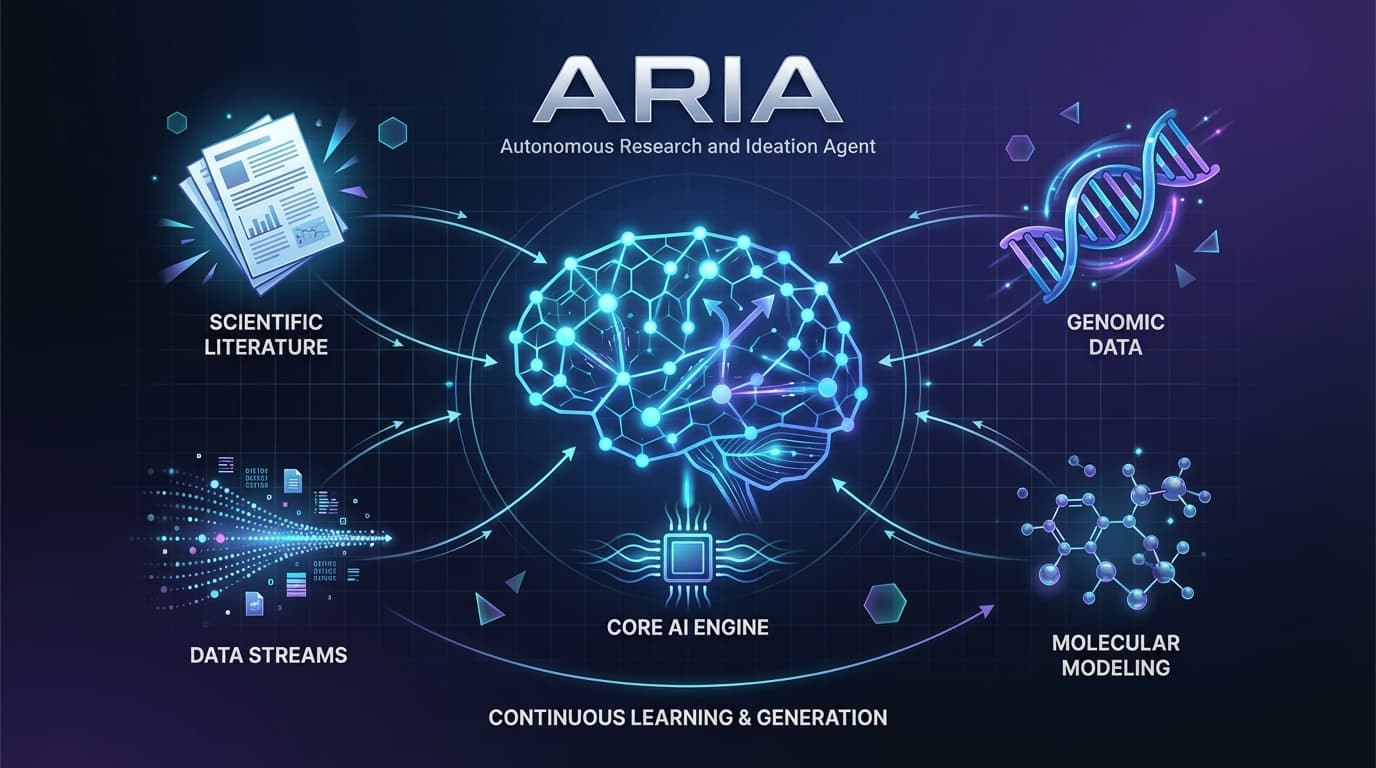
Most autonomous research agents are one-shot: loop, produce an artifact, exit. ARIA was built to run for months, accumulate signal, critique its own results and recover from its own failures. The same kernel was adapted across three organizations (a global pharma R&D org on public data, an enterprise setting, and SocialEyes retinal AI): 7 instances, 4 domains, 19,364 commits, 97.8% autonomous resumption, $86.92 of cloud compute, a published paper and a filed provisional patent. Its successor, ARIA-SE, runs continuously on a borrowed NVIDIA 8xH100 node, 8,700+ sessions in.
The problem
The One-Shot Ceiling
Nearly every autonomous research system shares one shape: an agent loop that runs, produces an artifact, and exits. That works for a single experiment. It cannot accumulate signal over weeks, react to a critic's verdict on yesterday's result, or stop itself when a research direction collapses. Real science is sustained.
- Agent loops that produce one artifact and terminate
- No memory of which directions stabilized and which collapsed
- Failures halt the run instead of triggering recovery
- Cloud GPU costs make months-long autonomous operation impractical
What I built
A Persistent, Self-Healing Flywheel
ARIA is a virtual research collaborator built to run for months. A weighted pool of research ideas competes on a single scoring function, the highest-weighted idea runs locally first and scales to cloud only if it earns it, a critic on a different model family posts a verdict, and failures classify themselves and re-enter the pool as recovery work.
- Six-stage flywheel: Pool, Score, Execute, Analyze, Critique, Self-heal
- Human-inserted and auto-generated ideas compete on the same scoring function
- Cost-asymmetric hybrid execution: local first, preemptible cloud only when earned
- DEBUG-driven recovery: 97.8% autonomous resumption across 321 failure events
- One portable kernel, re-pointed across three organizations and their domains
How it fits together
Architecture
ARIA separates the idea economy, the execution substrate, and an independent critic, so experiments accumulate into a shared corpus that later scoring decisions read from.
Timeline
How it went
- Dec 2025ARIA deployed on the homelab DGX: scored idea pool + six-stage flywheel
- Dec 2025 - Apr 202618-week run: 7 instances, 4 domains, 19,364 commits, 97.8% resumption
- Mar 2026Kernel re-pointed inside a pharma R&D org, on public data, as an adaptation test
- May 2026Provisional patent filed (patent pending)
- Jun 2026ARIA-SE forked onto a borrowed NVIDIA 8xH100 grant node
- Jul 2026Paper published on Zenodo; kernel released under Apache 2.0; ARIA-SE at 8,700+ sessions
What it taught me
Lessons
- Sustained beats one-shot: the value is in signal that accumulates over weeks
- A single scoring function lets human and machine ideas compete on merit
- A critic on a different model family catches what a model grading its own work never would
- Self-healing recovery is what keeps an unattended system alive across hundreds of failures
- Build the kernel once, re-point it at a new domain: portability was the thesis, and it held across three organizations
- Navari is agents working for a scientist on demand. ARIA is agents doing research unattended. Same builder, opposite shape, and each taught me something about the other.
Stack
Go deeper
Patent · Provisional patent filed May 2026 (patent pending)
Paper · Published 15 July 2026 on Zenodo, DOI 10.5281/zenodo.21383332 (CC BY 4.0); kernel released under Apache 2.0 at github.com/BioInfo/aria-paper
Connected work