ARIA
Autonomous research that runs for months. One kernel, three organizations, a published paper.
What it is
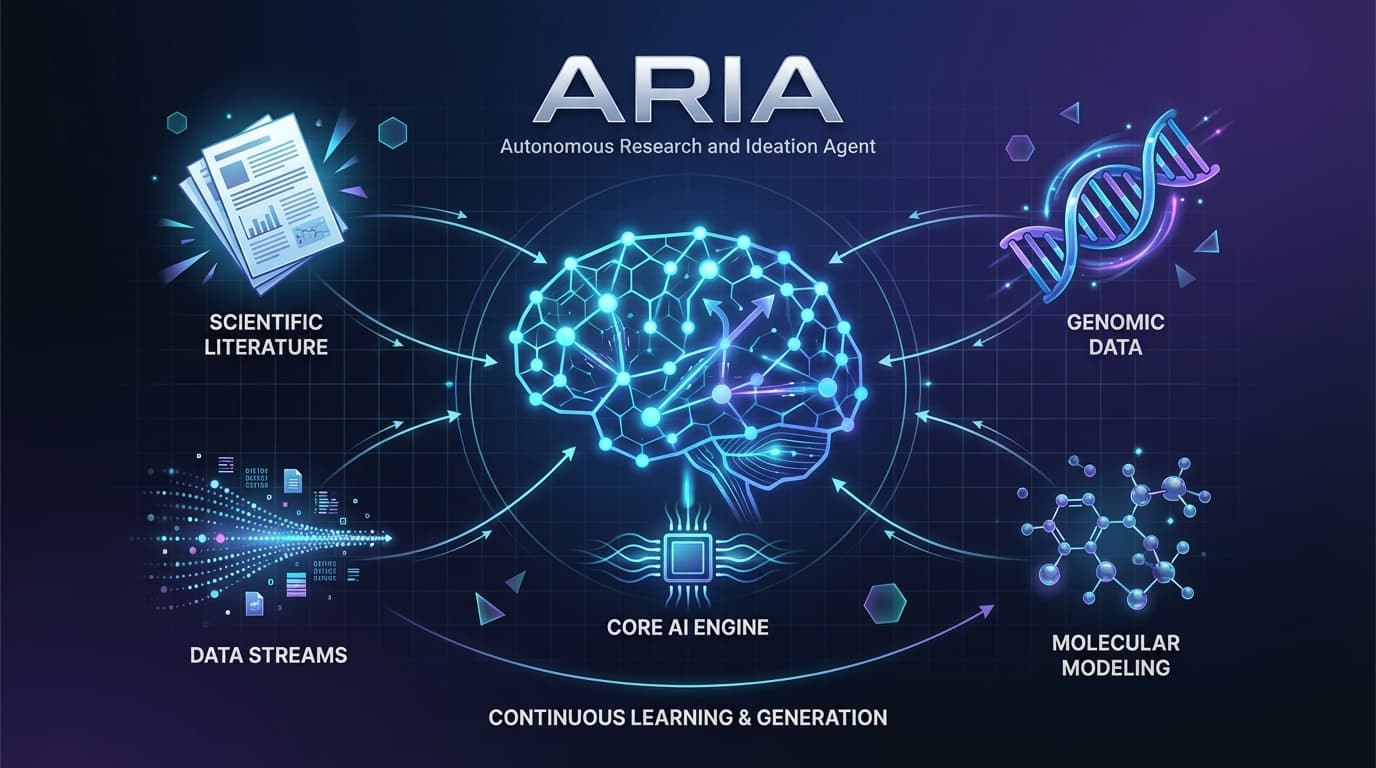
ARIA is a virtual research collaborator built to run for months, not minutes. Most autonomous research systems are one-shot: an agent loop produces an artifact and exits. ARIA accumulates signal over time, watches its own results stabilize, reacts to a critic's verdict on yesterday's experiment, and stops itself when a target collapses.
The pattern
One research kernel, adapted across three organizations. It was built once and re-pointed at a new domain each time. Inside a global pharma R&D org it ran on public data only, as a test of whether the kernel would adapt to a new field and a new set of questions. It did. Then an enterprise setting, then SocialEyes (retinal AI). Same flywheel, same operating principles, different science. Portability was the thesis, and it's what the paper set out to prove.
The deployment
Seven instances across four scientific domains over an 18-week window, late December 2025 to the end of April 2026. 19,364 commits. Roughly 17,800 autonomous sessions. 1,028 inter-agent artifacts. The longest instance ran continuously for 50 days. Total cloud compute: $86.92 across 900 preemptible runs.
The six-stage flywheel
- Pool: a weighted queue of research ideas, auto-generated by the agent or inserted by a human as steering.
- Score: weights move on red-team feedback, manuscript-gap signal, and explicit human boost.
- Execute: run the highest-weighted idea locally first, then on preemptible cloud GPU if it clears a quality bar.
- Analyze: compare the result against the hypothesis, write to the corpus.
- Critique: a separate agent on a different model family posts a verdict.
- Self-heal: a failed experiment triggers error classification, a recovery strategy, and a new pool entry.
Three design choices that keep the loop alive
- A weighted pool where human and auto-generated ideas compete on the same scoring function.
- Hybrid compute: every experiment runs locally first and scales to preemptible cloud only if it earns it.
- A DEBUG-driven recovery mechanism that hit 97.8% autonomous resumption across 321 failure events, including a 5,196-commit run with no human intervention.
The result
The retinal instance ran unsupervised for 50 days on a public retinal cohort, designing, executing and analyzing experiments on fundus images paired with clinical biomarkers. It produced a cross-platform age-regression generalization result across three fundus cameras. The numbers, the confidence intervals and the caveats are in the paper.
The paper and the patent
Published 15 July 2026 on Zenodo as "Sustained Autonomous Research Agents in Biomedicine: ARIA, an 18-Week Multi-Domain Deployment, and a Cross-Platform Retinal Biomarker Result" (DOI 10.5281/zenodo.21383332, CC BY 4.0), co-authored with SocialEyes' CTO. The kernel framework is released under Apache 2.0 at github.com/BioInfo/aria-paper. A provisional patent was filed in May 2026 (patent pending).
ARIA-SE today
The successor, ARIA-SE, runs the same kernel on a borrowed NVIDIA 8xH100 grant node, dedicated to retinal AI research for SocialEyes. Two weeks in (early July 2026) it had run 8,700+ autonomous sessions, 660+ experiments and 940+ scored ideas across 9 research domains, on the order of 550 sessions a day, and it was still running at the end of August. The build is documented in the Borrowed Iron series and walked through on video.
Where it fits
Navari and ARIA are the two shapes agents take in my work. Navari puts agents to work for a scientist on demand, inside an enterprise, with a human asking every question. ARIA runs research unattended for months, with a critic instead of a user. The pharma chapter of ARIA was pointed at the questions a growing agent platform raises, which is how the two met.
Timeline
How it went
- 2025-12-26Research That Runs Itself. ARIA starts its first run on the homelab DGX: a scored idea pool, a critic on a different model family, and self-healing recovery. Eighteen weeks later it has 19,364 commits across 7 instances; by July 2026 it is a published paper and a kernel under Apache 2.0.
Connected work