Continuum: Portable AI Memory
Identity that travels with you across every Claude interface
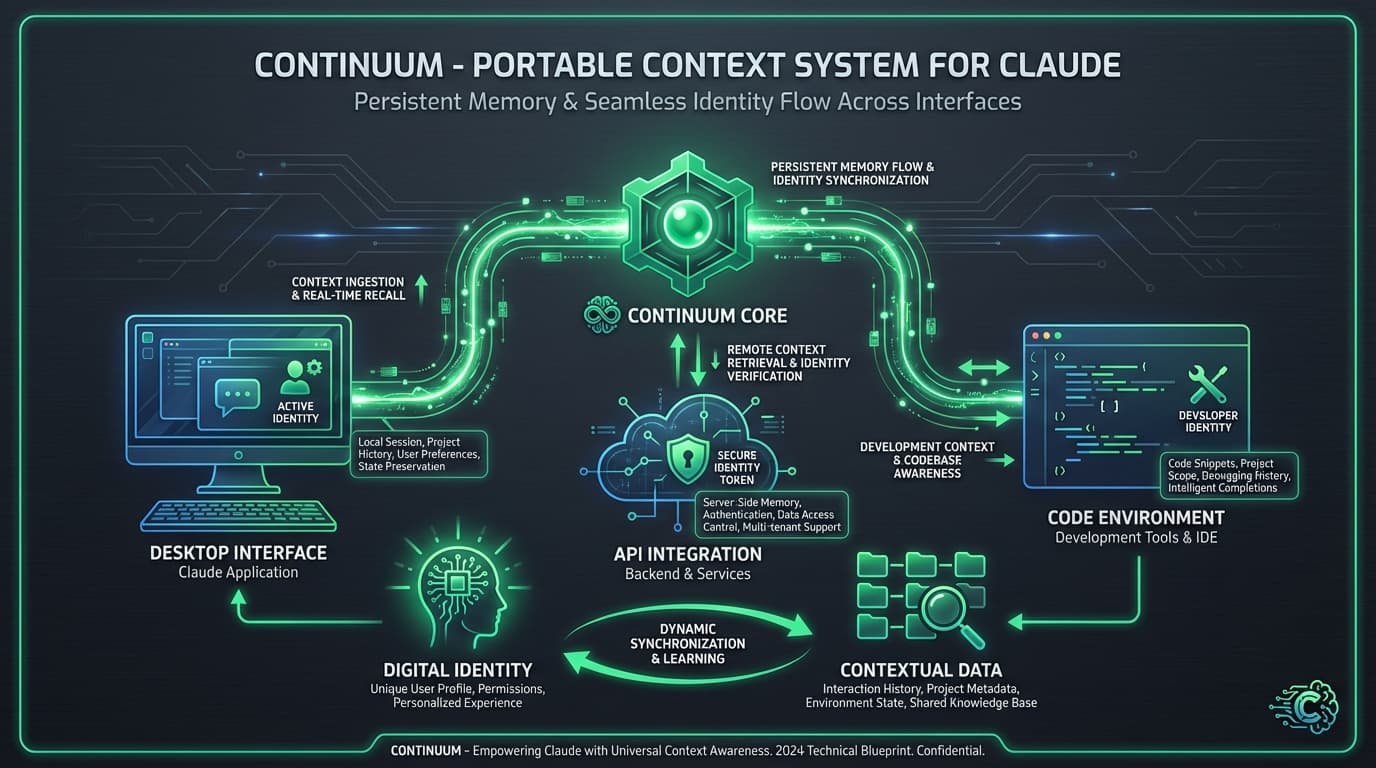
Building a persistent identity layer for AI assistants. Continuum solves the amnesia problem: every Claude session starts with full context of who you are, what you are working on, and how you communicate.
The problem
The Amnesia Problem
Every AI conversation starts from zero. You explain the same preferences, the same project context, the same communication style, over and over. And context does not transfer between interfaces: Claude Code knows your codebase but Claude.ai does not know your writing style.
- Every session requires re-explaining preferences and context
- No memory of past decisions or project history
- Context trapped in individual interfaces
- Accumulated understanding lost between sessions
What I built
Persistent Identity Layer
Continuum creates a portable identity that travels with you. Built on MCP, it exposes tools any Claude interface can access to understand who you are, what you are working on, and how you prefer to communicate.
- Voice and communication preferences stored and applied
- Project context and active work always available
- Decision history and rationale preserved
- Session wrap ritual auto-extracts learnings for future use
How it fits together
Architecture
MCP-based architecture enables any Claude interface to query the context store. The system maintains identity, memories, and working context as structured data.
Timeline
How it went
- Oct 2024Initial concept and CLAUDE.md approach
- Nov 2024MCP server implementation
- Dec 2024Session wrap ritual automated
- Jan 2025Cross-interface context sync
What it taught me
Lessons
- Identity is more than preferences: it includes decision patterns and working context
- The session wrap ritual is critical for accumulating institutional knowledge
- MCP enables clean separation between interfaces and persistent state
- Portable context fundamentally changes the human-AI relationship
Stack
Connected work